RSS Feed
Showing posts with label SEO. Show all posts

Mozilla Firefox's New Logo

I'm gonna be the first to break the news that Firefox has a new logo.

Okay, so it's really not a "logo," per se, but it's a very fitting emblem. Well, wait, what's a logo, anyway?

According to the font of all knowledge -- Wikipedia -- a logo is described as:

"A graphic mark, emblem, or symbol commonly used by commercial enterprises, organizations and even individuals to aid and promote instant public recognition."

Well, then I guess Firefox's new logo is indeed a logo. Only thing is, they didn't choose it -- I did.

Without further ado, HERE IT IS!


Even though I personally have chosen this as Mozilla Firefox's new logo, I feel it accurately depicts the browser and, well, anyone who uses it knows it definitely is recognizable :)

Google "Related to" Searches Can Leave Me Feeling Dead Inside

I'm a search marketer. Well, according to my boss-slash-husband, I'm a Digital Strategist. But whatever.

So today I'm doing PPC keyword research for a client. This particular client happens to be a women's wellness clinic, and the keywords were OB-GYN focused. Part of the research I do, I perform in Google AdWords' Keyword Planner Tool (which I don't like very much. I much prefer the old one). Another part of my research involves heading over to The Google and typing in some of the stuff I've found on the KPT...to see what Google is auto-suggesting for me.

ALSO on The Google, I take a look at the bottom of the page where the "searches related to..." section resides. There's some good stuff down there -- I mean, if The Google is suggesting it, odds are people are clicking on it (even though these recommendations are at the BOTTOM of the SERP. Yes, there IS life below the fold).

Anyway.

So I'm doing "OB GYN" type searches and this is what I'm seeing for auto-suggest and related searches:


No biggie. Pretty standard.

Aaaaaaaaaaaaaand then I type in "find a gynecologist." And things get...weird...in the "related to" section:


I mean, I trust The Google (most of the time). But, when they throw in something SO far off base that it can't even see the baseline, well...it makes me pause for a second. I mean, ONLY a second -- not like I'd go use Bing or anything!

I've been trying to find ANY other "related to" searches that're rotten eggs, and I'm having a hard time.

Has anyone else ever run across something THIS far outta line for Google "related to" searches???

April Fools' Day 2013: Google Nose

Google sure nose how to pull a good April Fools' Day prank. And The Google doesn't just stick to one form of tom foolery; oftentimes there are several pranks floating about for people to find.

One such prank for 2013 April fools is Google Nose (in beta). They're calling it "the new scentsation of search." You know how I love a good pun :)

Perform any search on The Google today and along with the traditional search verticals you'll find "Nose" as one of your options.


Good stuff!

Of course, this isn't news, per se...since Australia's in the future they've already been experiencing Google April Fools' Day for hours and hours now.

All-Knowing Google? Or Coincidence?

One of my Facebook friends posted that they were located at Los Muertos beach in Puerto Vallarta (of course, having just come back home from there, I grew instantly jealous and happy at the same time).

It got me to thinking of how Los Muertos beach got its name – and I couldn't quite remember the details, so thought I'd look it up. Well, the one place I KNOW I've read of the history of this Puerto Vallarta beach is on my parents' condo website (on the History of Puerto Vallarta page, of course). I typed the website address directly into a new tab of my Chrome browser and navigated to said page to read about it (again).

Then I thought, I wonder what The Google will show me when I search for it? So I performed a search for "los muertos beach puerto vallarta."

After scrolling through the first page results I glanced down at the related searches list...and gasped:


"View ANOTHER Puerto Vallarta vacation condo rental" ??? How'd you know I was even looking at a vacation rental? A lot of times Google will throw in related search queries or "related to" items after you've already searched something, but in this case, I didn't search! 

Curious.

But, of course then I realized how Google knew: 


Even though I hadn't searched for a condo rental in Puerto Vallarta, what I'd done was opened up a new tab and typed the address to my parents' condo website in directly (yes, they rent it out); then when I "left" that website I typed Google directly into the address bar and performed a (related) search.

Now, here's the kicker – did Google really "know" where I'd been or is it just coincidence? I was signed into my Google account, after all...is Google more "aware" of what you're doing and therefore will show me more relevant material?

I tried the search again after signing out...I still get that "related to" list item, but I've never seen that verbiage before in the related searches area.

Mystery? Coincidence? Or does Google just really know THAT much about what we're thinking and what we're doing on the WWW?


Self Promotion in Social Media: To Do or Not To Do?

I'm not a social media expert. Although, in this day and age, who IS? Has social media even been around long enough for a chosen few to have distanced themselves from the peloton and humbly declare themselves "experts"?

I think not.

The point is, EVERYONE these days is using at least some form of social media (except my sister, who contents herself with having virtually no online footprint), be it Facebook, Twitter, Flickr, Google+, Tumblr, Blogger, YouTube, Wordpress, LinkedIn, Pinterest...the list goes on and on.

Most individuals use these platforms to keep in touch with friends, post pictures, write journal entries (ahem...guilty), learn about what's new, build new relationships or any combination of those. No biggie...but then businesses started getting involved in the online conversation.

Are Businesses Using Social Media Correctly?

Okay, so with social media venues your business can reach out to your potential customers, current clients, industry experts, etc. I've interacted with several businesses via Twitter – whether to inquire about a product, offer up a thanks-for-a-job-well-done or to ask advice – and have been extremely pleased that these businesses had a quick response time, were very helpful and I even got a free product from one of them.

So what's the big deal with businesses using social media? Well, in those instances, the experience was positive and I felt even stronger about the company/product than I did before our behind-the-screen exchanges.

And then I see businesses misusing social media – namely, Twitter – to shamelessly self-plug their products and services.

Over...and over...and over...and over.

When did it become "okay" to blab ceaselessly on about oneself? Isn't the social media-verse all about relationships – finding like-minded souls, connecting with them, building relationships, sharing information, and LISTENING as much as (or less than) you talk?

Evidently some businesses – and, let's be honest, some individuals – think it's a perfectly acceptable practice to yak on and on about themselves without a care in the world for anyone else. Instead of an online conversation, they're rolling out their own red carpet with a long-winded diatribe.

That, my friends, isn't the way to use social media to advance your business. Trust me, no one wants to listen to a braggart. At best, no one will engage with your content and all you'll hear on the other side of your Tweet/post/share is silence; at worst, you'll be un-followed, de-friended, deleted and utterly ignored.

This Isn't My Opinion; It's What Others are Saying

But why listen to me? I'm no expert, as I alluded to at the beginning of this blog post...but I would like to share what other people on the Internet are saying about the very same topic:


There are a myriad of "do this; don't do that" opinions out there when it comes to using social media, but it seems the general consensus regarding business self-promotion is "that's not the point of social media!" I.e., don't do it. 

Should you not do it at all? No, that's not what we're – sorry, THEY'RE – saying. The point is: engage with other users; build relationships; share OTHERS' content; join in conversations (don't launch into manifestos); and then, when/where appropriate, offer up your expertise/content. But, like any other relationships you have, it's give-and-take...you need to listen to others as much – or more – than you talk.

Again, no one likes someone who ceaselessly self-promotes. I was reading an article that came through my Twitfeed just this morning about senseless SEO mistakes, and there it was again – the admonition NOT to build a self-centered social media strategy:


I think my favorite quote is "Only sleazy salesmen promote their own stuff without considering others."

How Google+ is Affecting Search Results

The latest buzz the last couple of days on the search scene is all about Google+ and how it's affecting search results. Danny Sullivan did some research and wrote up a nice article about how Google's definitely pushing Google+ in the SERPs.

I decided to run my own little experiment this morning, just to see what I could see. At first I merely compared results from searches performed when I was logged in to Google versus not.

First up: searching for myself ("Sarah Bernier Danks"). This one is interesting because I had JUST been messing around with my Google+ profile, so I figured that's why it was suddenly showing up front and center (it hadn't before), and without me even getting more than "sarah b" typed into the search bar...


And here's without me being signed in (notice I had to type in my full name here):


Then I decided to type in a co-worker's name – well, I guess he's a friend...whatever – while signed in. Interesting that although I'm searching for someone ELSE, my own Google+ profile is the second result, just because I mentioned him:


(Thanks for the picture, Dennis :)

Here's without being signed in (and I'm out of the picture):


Okay, that's interesting enough but I wanted to try more general searches, so I tried "actors" while signed in:


And then once more without being signed in...hmmm, same thing:


This got me to thinking, why are THOSE actors showing up (and why are Britney & Snoop showing up for "music")? Here's a (slightly) less "famous" search:


Interesting how Rand's Google+ profile is showing up right in the suggestions. So I thought, maybe that's not a fair comparison, since Rand is huge in the search marketing/online world. Let's go back to celebrities. 

I did a search for, well, you know...and here's what I got:


Obviously, I reasoned, he's not on Google+, since that result's not showing up like it does for Rand Fishkin...I mean, Rob has to be AT LEAST as popular as Randfish, does he not? But, upon further searching, here he is, alive and well on Google+:


I got the same results for Brad Pitt and Charlize Theron – nothing showed up in searches for them, either, even though both have Google+ profiles. What the hell, Google? Why're you picking and choosing who "gets" to have their Google+ profile show up in your suggestions?  

Breathe. Relax. Try another search ("Minneapolis ad agencies") while signed in:


While it's fun to see ThinkSEM (a really great search marketing company based right here in the Twin Cities) show up for this search, is it the most relevant, considering the context in which ThinkSEM deals with ad agencies, versus actually BEING an ad agency? 

So here's my SERP without being signed into Google:


I'm finally getting to a point that'll hit closer to home with those of us who like to call ourselves Search Engine Marketers...what'll this do to the amount of time (in the near future since this has all started happening) we'll have to spend on the phone and in meetings with clients patiently explaining (and re-explaining) WHY we – the experts they're paying for optimization – can't control the SERPs and "how come at home I'm showing up NUMBER ONE and at work I'm NOT??" Or whatever else they're going to come up with whilst they continually while away the hours Googling themselves...

Only time will tell if Google will continue to "get away" with promoting Google+...and what affect it'll have on the way we search and optimize moving forward.


All-Flash Websites Still Not Okay

Even though Google's announced they're even better at indexing Flash (SWF) content, don't get all excited and build a website all in flash because "it'll look cool, and Google can read all the content now!" For real. If you care ANYTHING about measuring the success – perceived or otherwise – of your online marketing efforts, an all-flash site isn't the way to go. At least, not yet.

Let's step back for a minute. "Hang on a tick," you say..."hasn't Google been able to penetrate Flash files for a couple years now?" Actually, yes – since the beginning of July 2008, Google's been working on being able to read and index Flash files, even updating last year to being able to index external content loaded from other files and associating it with the "parent" SWF file.

All this is awesome! Google continues to move right along and improve...but should you be building websites entirely in Flash because of this? I don't know....but my guess is probably not.

Here's why: even with this heightened ability to read/index SWF content, will a website built entirely in Flash still appear as one page? Currently, that's the case. Sure, The Google can read and index your Flash content. BUT, a site built in Flash registers as a single web page. "So?" you might scoff. Well, again, if you're interested in tracking any sort of data on your pretty little site, you MIGHT want to re-think Flash.

Check it out:


This is all the data Google can (as of this morning) gather for a website built entirely in Flash, which consists of 6 or 7 "pages" – to a human – but only 1 to Google. Visitors can enter, click around, and see different content, but Google perceives each visitor as hitting "only" the home page...since, technically, no other "page" exists (look at the address bar when viewing an all-Flash site; you'll see what I mean).

Maybe this newest advancement in reading SWF/Flash content will prove me wrong. But, maybe it's a glitch they haven't worked out yet...or might not ever be able to.

So, while a Flash website can look "really cool," "innovative" and "cutting edge," is it worth anything if you're looking to measure its success with analytics???

Answer: nope.

Hey, Idiot, Press "Enter"

Boy, Google Instant sure has the world in a tizzy. From "I don't want to be shown a SERP without hitting 'Enter'" to "Why don't they censor Google Images like they censor Web searches?" C'mon, people, admit it...Google has more (perceived) power over you than you a) realize and/or b) will admit.

Upon reading Danny Sullivan's article about G is for Girls Breast Feeding Each Other I saw the video Max Goldberg – some random stand-up guy – did in which he spouts off about how Google's censoring the entire Interwebz and not allowing searches on certain words. He's actually kinda funny, but he's either trying to stir up a hornet's nest or he's an idiot. If he truly thinks Google won't allow him to search certain words, he might need a lesson in how The Google works.

So, here's a quick tutorial on how to MAX-imize your SERP (PS, buddy, that means Search Engine Results Page)*:

Step 1: If you don't have a Google toolbar, then type google.com into your address bar (if you don't know these terms, I can't help you). This should get you to something that looks like this:
Step 2: Type in a word – ANY WORD – to start searching.


Okay...here's a better example:


Here's the neat thing with Google nowadays – it'll not only suggest results (without having to hit "enter" on your keyboard or even the "Search" button...which is SOOOOO 2004); it displays them REAL-TIME! Sweet! However, that might not work for all searches, which brings us to...

Step 3: If your search is "censored" from Google Instant – meaning Google doesn't want to automagically display results for certain, shall we say, sensitive keywords – you're still able to research that material. Hang onto your hats, folks, I'm going to tell you how to get around the "massive, unforgivable censorship" imposed on us by The Google.

Ready???

PRESS ENTER.


That's right, I've have single-handedly found the way around Google's censorship. If Google doesn't want you to see Instant results, you hafta hit your 'enter' key. Whew. I'm gonna call it a day.

Of course, maybe I WANT to see "blacklisted" results without having to hit "enter" – define lazy – and that's what this whole thing is all about. Then you'd think They would let Us define this by setting our filters.


BUT, what about shared and/or public computers? Poses a rather delicate situation...one which I think Google is – overall – handling very well.

But I digress. So, to recap, it's as easy as 1, 2, 3 to search on Google. For those of you who REALLY can't figure it out – like Max Goldburp – here's another, quicker, live tutorial. I.e., let me Google "lesbians" for you, idiot. 


*Disclaimer: I'm not a teacher nor do I have any special ed type of background, so results when utilizing this tutorial may vary based on the IQ of individual searchers.

Dear Jill Whalen...You Actually ARE A Fool!

...Or, I Really Thought That By 2010 Jill Whalen Would Figure It Out
Back in 2005 when I serendipitously fell into the SEO world, the company at which I worked invited Jill Whalen to come and talk. Since I was literally about 2 days into my role I had no clue who this chick was or what was going on. I really couldn't tell you what she talked about but I DO remember thinking it was neat that a writer also knew search optimization. Never woulda figured her for a whiner.

That was 5 years ago and boy, has the world of search marketing sure changed. Which is okay – it's a dynamic environment, after all. The point is, if you truly call yourself a "Search Marketer" you need to move right along with the times and keep up on new advancements.

I'm not going to say I'm up-to-date on everything; I do know that optimization tactics and paid search marketing have drastically changed since '05: for the better, I might add. It's only ever ANY search engine's objective to return the most relevant results to its users...otherwise said users will ditch search engine A for search engine B.

Whether anyone likes it or not, The Search Engine is Google and while the others (yes, there are others) strive to keep up, Google sets the bar for search engine capabilities. And, do you know what? If you don't like it, then get the hell offline. To be honest, if you don't like rules and regulations, you shouldn't be a marketer at all. It's the same with traditional marketing, people.

Are we, as SEOs, trying to please Google when we take on a website or PPC client? Hell no. We're following protocol – as any marketer does in ANY discipline, such as PR, media planning, etc. – and applying our knowledge to create a marketing campaign which will positively affect ROI.

Enter purported SEOs who bitch about Google's RULES and how they don't WANNA be a marketer beholden to an online conglomerate. Does the whiny tone come through? It should...just like in Jill Whalen's little passive-aggressive rant about how she looks like a fool all because of Google.

She whines and cries about how Google condones link buying, keyword-stuffing, doorway sites and "crappy articles" submitted to bullshit networks full of – you guessed it – other crappy articles. She also claims to have been telling people for a decade that "the way to be found in Google is to have one, great, all-encompassing website." See, and here I thought the more niched the content, the better chance it had of competing.

According to her, Google "single-handedly created the entire link-building and link-buying industries" and that "Link building is the most distasteful, horrible act to have to perform for a website." No one's asking you to do anything you don't want to do here, Jill ('cause no always means no)...if you don't want to acquire credible, relevant, topical links for your clients' websites, then DON'T. If you don't want to create websites around targeted, descriptive, relevant content, don't.

There are a lot of other accusations in her rant, all of which accuse Google of showing only spammy sites in their SERPs. Once more, I don't quite know what she's talking about, but this I do know:

Sounds like someone's pissed off that the websites she creates aren't ranking #1 in Google. Somewhat reminiscent of what people complained about 5 years ago. Might have to move with the times, Jilly-girl, and read up on some advancements. If you're a true SEO, then you KNOW online marketing changes. Just sayin'.

This isn't the first time we've seen her head on a tirade about something which actually isn't true. It seems she likes to take words and ideas and twist them to make people (or search engines) look evil, like she did here.

Also, I'd like to add I truly enjoyed how you bash, bash and beat the dead horse and then, at the end, with a casual addition of a "P.S.S." (no clue what that means, I think she meant it as a post postscript, but I'm only guessing) she adds this little nugget: "(Google) You're still way better than the other search engines!"

So, a search engine which you say returns ONLY spam and makes you look like a fool is way better than anything else you'd use to find content online? Yikes. Define: FOOL.

*Also...did you notice how, even though she HATES link building, by writing something controversial she garnered a link (albeit from my rinky-dink, personal blog)? Yes, I do realize I offered it up; I merely wanted to make a point :)

Google Suggests Instant Search

Remember when we first saw Google Suggest?

I thought it was annoying. Then I got used to it and didn't heed the – what I considered to be – random suggestions.

Then I not only started paying attention, I started USING said suggestions. Wow, Google really knows what I'm searching for! Thanks, Google :)


It didn't take long at all to start implementing keywords – whether for a site optimization or PPC campaign – based on Google's suggestions. Hey, if Google's suggesting it, you have to figure a) SOMEONE'S searching for it, and/or b) someone's going to click on that suggestion because Google suggested it.

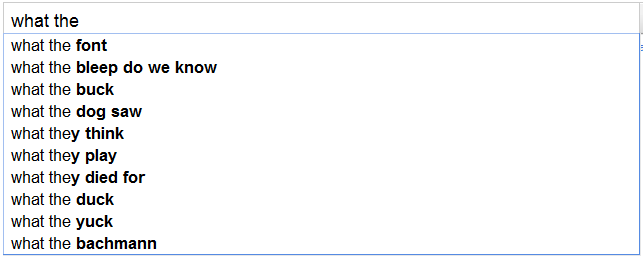
Of course, it was also funny to search for the neatest, most hilarious suggestions for random stuff...


Well, there's a new type of suggest now. This morning Google announced their faster-than-the-speed-of-type search, Google Instant. Not only does Google suggest what you should TYPE, they're suggesting what you should click...before you even finish typing. That's right, as you type, your SERP changes in real-time. You don't even need to finish typing – or hit "return" – in order to access your results.


A picture doesn't do it justice; you really need to experience it to get the full effect. Hint: you have to be signed in and thus far it's only worked for me in Chrome.

The question is: what will this do to search? What will it do to all those egomaniacal crazies out there who want to rank for generic terms? Will they now insist on ranking for letters???

Google Thinks Sexuality is Important

We all know Google shows sitelinks for the cool kid sites – i.e., reputable websites – but the question here isn't "how do they determine which sites get sitelinks in their rich snippets?" Rather the question is, "how does Google determine which links get placed into the sitelinks snippet?"

From the horse's mouth – none other than Mr. Google himself – we learn that "we (Google) show sitelinks whenever we think that they might be especially helpful for someone...the way we compute that is algorithmic." See the full video here.

Interesting. Normally, with consumer sites, say West Photo, we'll see sitelinks such as "Rental List," "Promotions," etc:


While that's all well and good, yesterday I happened to stumble across an interesting rich snippet for the Yahoo Directory...it seems Google thinks sexuality is not only "helpful," they think it's ESPECIALLY helpful:


Go, Google!

What'll be interesting to see is whether or not Yahoo decides to change that (by utilizing Webmaster Tools). If not, then go Yahoo!

Has anyone else run across other interesting sitelinks?

Attention! German Government Not Web Savvy

Google Analytics CookiesWhile catching up on tweets this morning I ran across an interesting article regarding Germany's declaration that Google Analytics is illegal. Was?

Evidently, according to the German government, the use of Google Analytics to track website users' information is a violation of people's rights, since they're not giving their consent to be tracked.

Okay, stop right there, regierungsbeamte, just because you happen to be government officials doesn't mean you know best. Thing is, you don't even have the technical savvy to know that people who use the Internet DO have a choice of whether or not to be tracked.

It's called disabling cookies, FYI. Now, does the average Joe even know a) he's being tracked via cookies or b) that there's an option not to allow cookies in the first place? Perhaps. Perhaps not. I'll venture a guess he doesn't really pay attention, plus there's no danger of sensitive information getting out from the placement of cookies.

Cookies don't work that way - they're placed on a computer for a specific purpose (to track the user as she visits sites on the Web). Specifically, Google Analytics only places 1st-party cookies, so only Google Analytics can 'tap into' the information for that cookie, so to speak. There's a lot more to Google Analytics cookies than meets the eye, but the general lesson here, Germany, is don't "impose fines on companies who use the service to gather detailed stats based on their website visitors’ usage patterns," because they're not doing this "without the explicit consent of those visitors" ... those visitors have the option of not being tracked.


*Image used came from semseoexpert.com.

Why Don't I Show Up in Social Search?

Today Google officially rolled out its social search function, a way to customize your SERPs to include results from people within your very own network. Pretty neat, considering the vast amount of people we can be linked to and the amount of content to wade through out there in search engine land.

Danny Sullivan has a great post about this, in which I was surprised to learn that a person can show up in their own searches (with the 'social' option). It struck me as odd until I read his explanation of it,
"...my own blog is listed. That makes sense, in a way. I know myself, and I write about Newport Beach a lot."

Intrigued, I instantly opted into the Google Experiment and started searching. I tried an easy test first - "SEO" - since a good number of my friends on Twitter are SEOs. Bingo:


At the bottom of the SERP, my very own results. The dude in the 'stache is a friend...and the second result is my very own husband. Now, why wouldn't Clint's 'result' show up before Chris's, since we share the same last name (therefore, Clint would be more relevant to my search)? Well, that's not the way this social search works - even within "my" social results, they're still ranked based on the traditional Google algorithm, meaning in Google's mind webranking.com is more important than thinksem.com. For now anyway :)

Ever the narcissist, I tried another search, something for which I figured I'd show up for. Something I blog/talk about a lot: my dog. So I chose "german shepherd" and scrolled to the bottom of the page - nada. What? Where am I? Shouldn't I show up in my own social network for something I blog, micro-blog, and talk about often? Hmf. Evidently not.

Okay, different search - "music" - SOMEONE I know must be mentioning something about music. Lo and behold, when I click on my 'Show Options' view and then narrow it down to 'Social,' here's what I see:


Wait, Cities 97? I don't follow Cities 97 on Twitter...oh, wait, but one of my co-workers does. While I certainly respect her choice to support easy listening, I'm personally not interested in that station. Even though it's very relevant to music, I personally have no connection to it so don't think it's a relevant result here.

So, for my last search (in this 'test') I tried something else. I'm connected to several of my co-workers via Facebook and Twitter, so I performed a search for my company's name, expecting to find at least a few co-workers who've mentioned where they work. The only result came from a co-worker who follows ME on Twitter, but I do not follow this person.

Thus far, Google, I don't vote it a total FAIL, but I do have some grievances with how this works. Why am I not showing up for my own "relevant social searches" but people/entities I don't even follow do show up?

Looks like there could be a couple bugs yet to work out with this.

*PS: Yes, I have a Google Profile and had it long before this post.

An SEO Writer Picks a Fight

In my Twitterfeed this afternoon, I stumbled upon (yes, pun intended) a Search Engline Land article by Jill Whalen: Is Choosing Search Engines Over Users A Fatal Flaw In SEO? I love the 'question' article title, it's like waving a red cape in front of a Spanish-bred bull: you have to at least click to open and scan.

Immediately I see she's written this article in rebuttal of a @randfish blog post titled Terrible SEO Advice: Focus on Users, Not Engines. Again, a catchy headline since he does touch on that angle, but it's not really what he's actually saying in the post.

In Jill's little back-at-ya attempt at setting the record straight, she spouts off about how Rand's article "could potentially set SEO back at least at decade," in her opinion. Really? Well, Jilly-girl, you might want to actually READ what Rand wrote, instead of just scanning (as so many website users are wont to do), 'cause you didn't even grasp what he said. (Also, might wanna run the ol' document through at least a cursory proofreading process...you ARE a writer, after all.)

Here's what Jill has to say about Mr. Fishkin's advice:

In the article, he apologized to his audience of budding SEOs for having ever told them to do what’s right for their users. In fact, he called putting your users first, “utterly false and tragically misleading.”

If you listen to this advice, your SEO will be fatally flawed from the get-go.

You go, girl. Except...wait...this is what Rand ACTUALLY wrote:

If you've been around the SEO world a while, you've undoubtedly heard the old adage:

"Do what's right for users and engines will reward you with higher rankings"

Along with its peer:

"SEO tactics that focus on engines, rather than users, are manipulative (black/gray hat) and will eventually be discounted or penalized"

In my opinion, both of these statements are utterly false and tragically misleading. In my view, SEO starts with the user (of course), but cannot ignore the incredible importance of search-engine targeted (and specific) tactics.

So let me sum it up for you, Jill: Rand was merely stating that new SEOs deciding to totally adhere to only one of those adages (and therefore utterly ignoring the other) are making a mistake. Your mistake, my dear, was criticizing a much bigger name in the SEO world than you are, without even the proper information.